01 · The question
Could a domain expert direct agentic teams to build a real system?
Flash started as a deliberately ambitious test. Android device management brings meaningful product, security, and operational constraints.
OPEN-SOURCE CASE STUDY
Flash is a working, open-source Android management platform created to explore the new economics of LLM-assisted software development, and to make the result inspectable.
Built on the Android Management API · AGPL-3.0 · An open technical exercise in Android MDM development
WHY FLASH EXISTS
The point was to test what changes when an experienced practitioner can work with agentic development teams, and where human judgement still matters most.
01 · The question
Flash started as a deliberately ambitious test. Android device management brings meaningful product, security, and operational constraints.
02 · The method
LLM agents accelerated implementation, while architecture review, security hardening, tests, and deployment work made the resulting system something others can inspect and challenge.
03 · The result
The repository includes the application, tests, deployment guidance, API documentation, and licensing context. Together, they document the workflow behind the proof of concept.
These are implemented surfaces in a working proof of concept, intended to be inspected alongside the source, tests, and project history.
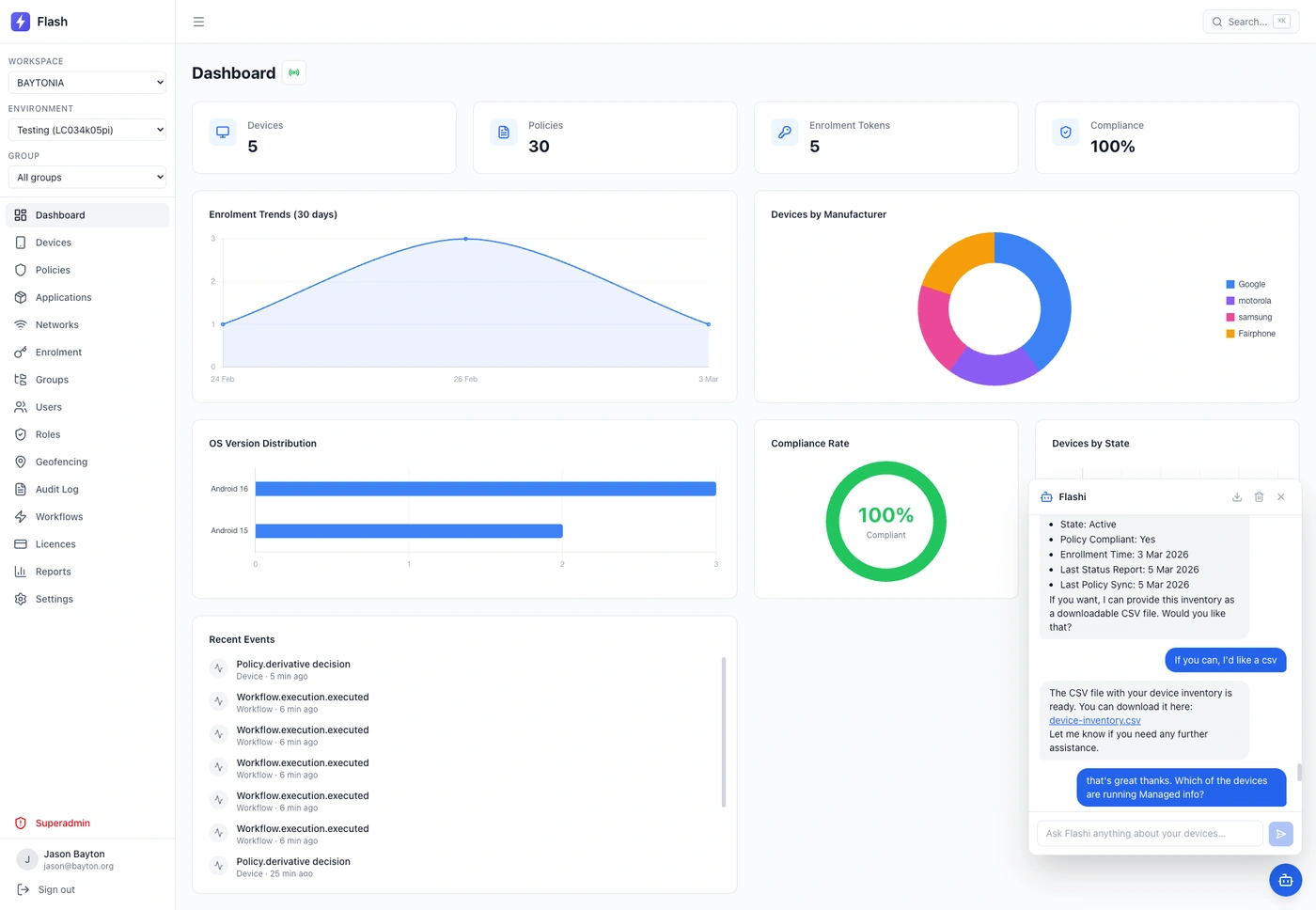
Monitor device metrics, enrolment trends, compliance rates, and OEM breakdowns. Configurable dashboard widgets with live data.
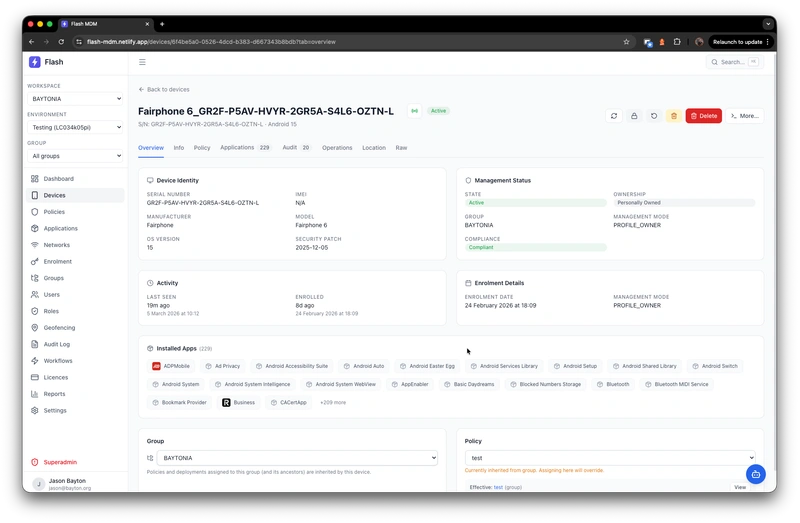
Full inventory with detail views. Lock, wipe, reboot, and track device locations. Bulk operations with progress tracking and async processing for large deployments.
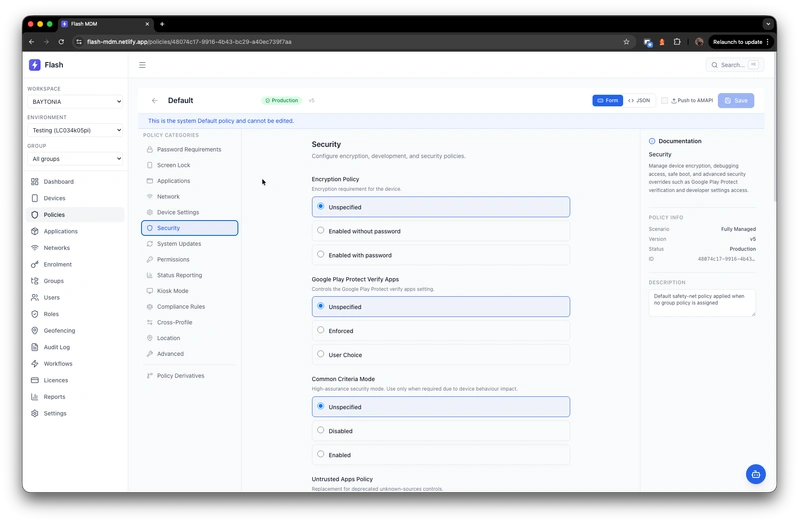
Component-based policy system with deep-merge inheritance. Visual and JSON editors with version history. Derivatives auto-generated per scope with variable substitution.
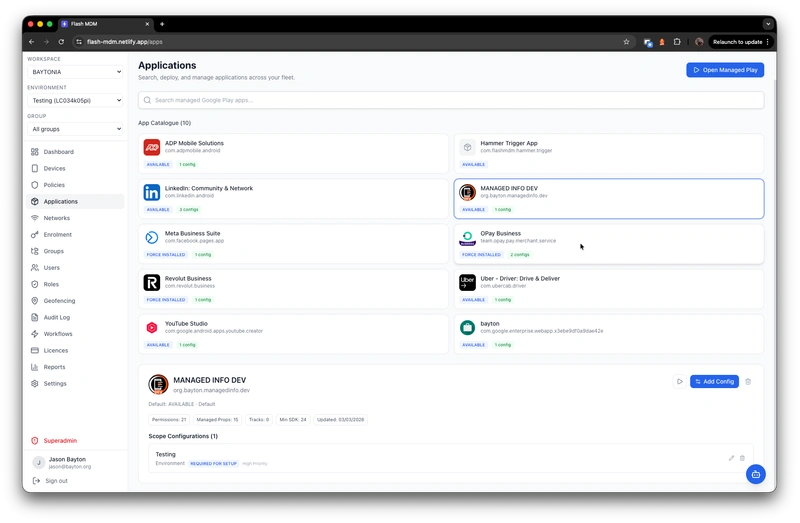
Managed Google Play integration with app catalogue browsing. Multi-tiered deployment across environments, groups, and devices. App configuration management and import/export.
QR code tokens with configurable duration (1-365 days). One-time-use tokens, group-scoped enrolment, and provisioning extras including Wi-Fi, locale, and timezone.
Closure-table group hierarchy with cascading policy inheritance. Environment, group, and device precedence model with group-scoped policy overrides.
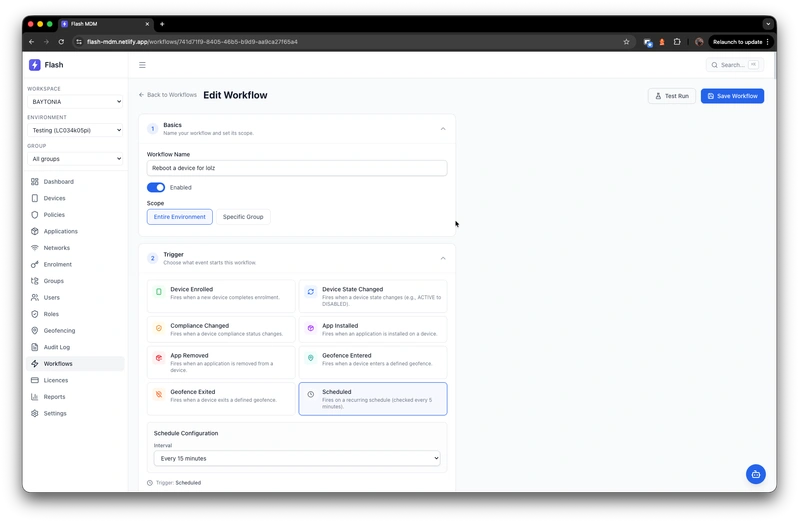
Event-driven and scheduled automation. Triggers on device state changes, compliance changes, app installs, and geofence events. Conditional evaluation with field/operator/value rules.
Circle and polygon-based geofences on Google Maps. Per-device inside/outside state tracking with custom actions on boundary entry and exit.
Natural language queries against workspace data with Flashi. Query devices, policies, applications, and groups conversationally with chat history persistence.
RBAC with workspace/environment/group scoping. TOTP MFA, scrypt password hashing, AES-256-GCM encryption at rest. Server-side audit logging with sensitive field redaction.
Export devices, policies, audit logs, and applications as CSV or JSON. Configurable date ranges and format options with full data portability.
Stripe-powered plan-based licensing with per-device seat management. Configurable billing cycles (1-36 months) and automated overage detection with grace period enforcement.
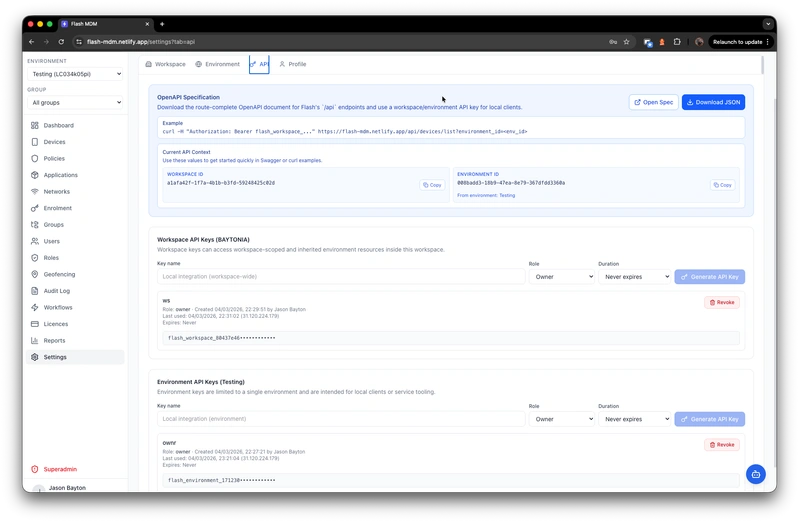
87 HTTP API endpoints with OpenAPI specification. Workspace and environment-scoped API keys with last-used IP tracking. Bearer token and X-API-Key authentication.
Workspace, environment, and group hierarchy with isolation enforced at authentication, authorisation, and database scoping. Configurable access scopes per user.
Every device in your fleet at your fingertips. View hardware details, management status, installed applications, applied policies, and location, all from a single detail view. Send remote commands like lock, reboot, or wipe, and track operations history in real time.
Build policies visually or edit JSON directly with syntax highlighting and live documentation. The component-based system lets you create reusable policy fragments that deep-merge by priority. Derivatives are auto-generated per scope: environment, group, or device, with variable substitution for dynamic values.
Browse and deploy applications from Managed Google Play directly within Flash. Configure app settings, assign apps across environments, groups, or individual devices, and manage your entire application catalogue from one place. Import and export configurations for consistency across environments.
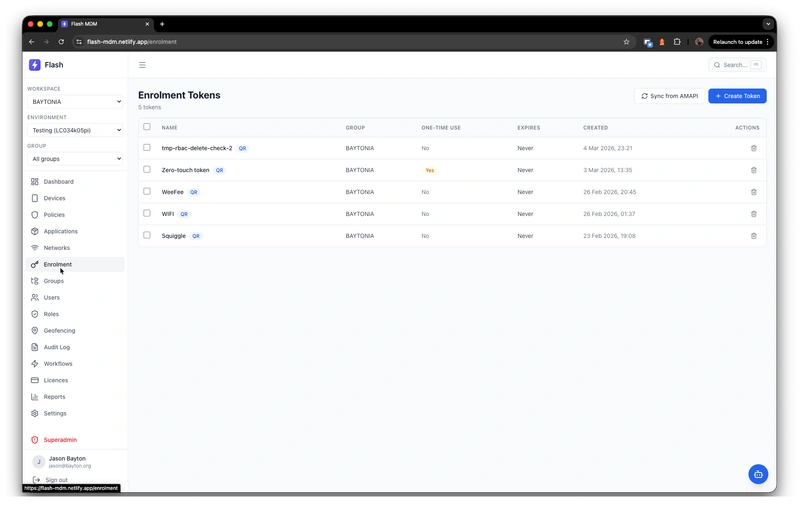
Get devices managed in minutes with QR code tokens, zero-touch provisioning, or sign-in enrolment. Configure token duration (1-365 days), one-time use restrictions, and provisioning extras like Wi-Fi credentials, locale, and timezone, all merged into the QR payload automatically.
Eliminate manual device operations with event-driven and scheduled automation. Trigger actions when devices enrol, change compliance state, enter a geofence, or on a cron schedule. Define conditions with field/operator/value rules and let Flash handle the rest.
87 HTTP endpoints with a full OpenAPI specification. Create workspace and environment-scoped API keys with last-used IP tracking. Integrate Flash into your existing toolchain with Bearer token or X-API-Key authentication and comprehensive CRUD coverage across every resource.
Explore the platform's key screens and features.
Flash is open source so its claims can be tested, its decisions debated, and its approach improved.